
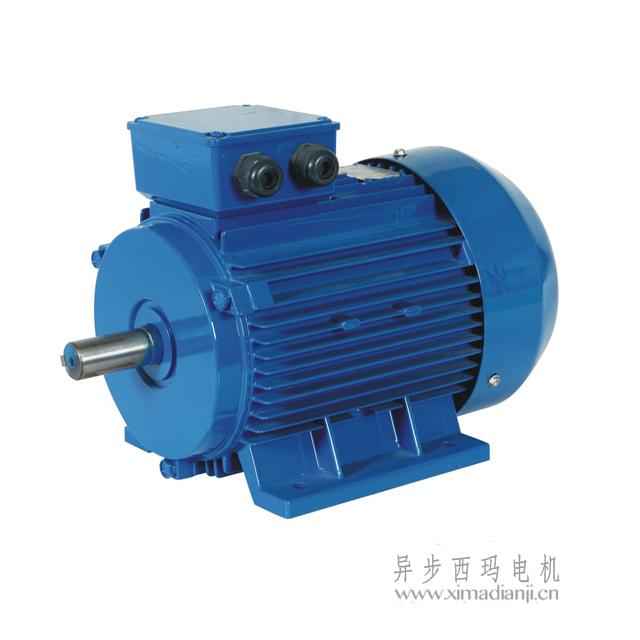
YVF2-315M-4 variable-frequency speed-regulating motor, 132 kW, 5–100 Hz, 380 V.
I. Overview of the YVF2-315M-4 132 kW, 5–100 Hz, 380 V Three-Phase Asynchronous Inverter-Fed Adjustable-Speed Motor
This product is a compact inverter-fed three-phase squirrel-cage asynchronous motor. This series offers a wide speed-adjustment range, eliminates torque pulsation at low speeds, and features high starting torque and low starting current, low noise, and minimal vibration. Its power ratings, mounting dimensions, and frame center heights comply with IEC standards and match those of the Y-series (IP44) three-phase asynchronous motors.
The motor’s protection rating is IP44 (optional IP54 or IP55); cooling method is IC06; duty type is continuous (S1).
II. Operating Conditions for the YVF2-315M-4 132 kW, 5–100 Hz, 380 V Three-Phase Asynchronous Inverter-Fed Adjustable-Speed Motor
2.1 The inverter’s output power must be greater than or equal to the motor’s output power (determined according to actual load characteristics).
2.2 The cooling fan’s power supply is three-phase 380 V, 50 Hz; the fan’s rotation direction must match the direction indicated by its arrow. The cooling fan must start simultaneously with—or prior to—the motor to prevent excessive motor temperature rise.
III. Pre-Installation Inspection of the YVF2-315M-4 132 kW, 5–100 Hz, 380 V Three-Phase Asynchronous Inverter-Fed Adjustable-Speed Motor
3.1 After unpacking, inspect the motor for damage incurred during transportation, and carefully remove dust and rust-preventive coating from the motor surface and shaft extension.
3.2 Verify that all data on the motor nameplate meet specified requirements.
3.3 Check whether all components are fully assembled and whether fasteners are loose or missing. Manually rotate the rotor to confirm smooth, free rotation.
3.4 Measure the insulation resistance of the motor and fan motor using a 500 V megohmmeter; the value must be no less than 0.5 MΩ. If below this threshold, drying treatment is required; during drying, the maximum winding temperature must not exceed 120 °C.
3.5 Verify compatibility between the inverter and the motor, and confirm whether the grid voltage meets specifications.
IV. Installation of the YVF2-315M-4 132 kW, 5–100 Hz, 380 V Three-Phase Asynchronous Inverter-Fed Adjustable-Speed Motor
4.1 The motor may be driven via coupling, spur gear, or belt pulley.
For motors with higher power and speed ratings, belt drive should be avoided whenever possible. If belt drive is unavoidable, an indirect arrangement is recommended (see Figure 1) to prevent shaft breakage caused by improper operation. For low-power motors using belt drive, avoid excessive belt tension to prevent shaft fracture.
4.2 When using belt drive, ensure the motor shaft centerline is parallel to the load centerline, and the belt centerline is perpendicular to the motor shaft centerline; when using coupling drive, align the motor shaft centerline precisely with the load centerline.
4.3 For vertically mounted motors, only belt pulleys (or equivalent to standard belt-pulley loads) are permitted—no additional axial-load devices may be applied.
4.4 The motor installation site must provide adequate ventilation and cooling. Motors must not be installed in locations exposed to direct sunlight or rain.
4.5 The motor must be mounted on a stable, rigid foundation.
4.6 Wire the motor correctly according to the wiring diagram inside the terminal box. To reverse rotation direction, interchange any two phase supply leads.
V. Operation of the YVF2-315M-4 132 kW, 5–100 Hz, 380 V Three-Phase Asynchronous Inverter-Fed Adjustable-Speed Motor
5.1 If the supply voltage and frequency deviate beyond the inverter’s specified tolerance range relative to its rated voltage and frequency, the motor cannot guarantee continuous rated-power output. Motors operating continuously must not be overloaded.
5.2 When the motor operates at lower frequencies (e.g., 5–15 Hz) with constant torque, the inverter’s low-frequency torque compensation function shall be employed according to the load condition (e.g., for Japanese Kasuga inverters, select the H-5 compensation mode at 5 Hz ); otherwise, excessive motor temperature rise may occur.
5.3 During the entire speed-adjustable operation, monitor the motor current variation. If the current exceeds the rated value, the motor will experience overload, causing excessive temperature rise and even burnout.
5.4 When operating unloaded or under load, the motor must not emit intermittent or abnormal noise or vibration. Bearing temperature must not exceed 95 °C.
VI. Maintenance and Storage of the YVF2-315M-4 132 kW, 5–100 Hz, 380 V Three-Phase Asynchronous Inverter-Fed Adjustable-Speed Motor
6.1 The motor’s operating environment must remain dry, clean, and well-ventilated; motor ventilation must not be obstructed by dust or fibers.
6.2 During motor operation, continuously monitor and record the inverter’s displayed data; operating time, maintenance results, and fault handling must also be documented. If any abnormal noise is detected during operation or if the inverter displays a fault, immediately stop the motor for inspection. Under no circumstances shall restart attempts be made before the fault has been identified and rectified.
6.3 Ensure good bearing lubrication throughout motor operation. For three-pole motors, replenish or replace No. 3 general-purpose lithium-based grease after 2,000 hours of operation; for motors exceeding 4,000 hours of operation, replenish or replace grease (YJTG355-2: high-speed, high-load grease). Sealed bearings require no grease replacement within their service life.
If bearing overheating or grease degradation is observed during motor operation, promptly replace the grease. Fill the bearing chamber to two-thirds (2/3) capacity with fresh grease.
6.4 If the motor is not to be used immediately, store it properly. Store the motor in a clean, cool, dry warehouse—not in a damp, acidic/alkaline, rodent-infested, or otherwise corrosive-gas-containing warehouse ( ).